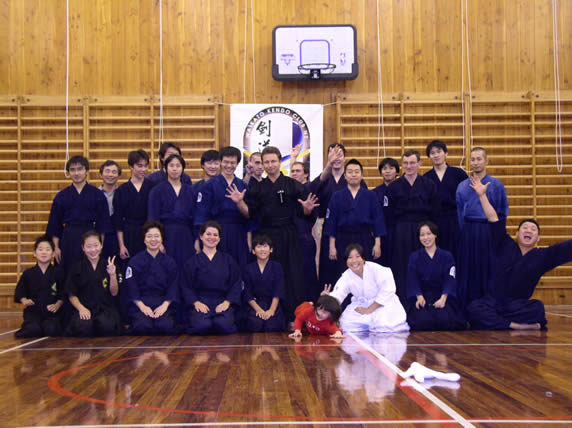
Iaido seminar at Waikato


The first ever I-ai-do seminar in our club will he held on Tuesday 24 May from 6.30pm to 9.00pm. All members are welcome to attend.

I think all of us will be I-ai-do beginner at that night. You don't need to feel bad but just turn up and enjoy yourself. The only thing you need to bring is Bokkuto (wooden sword).

Mr. Brent Hansen, a Kendo (5th Dan) and Iaido (4th Dan) instructor from Auckland Kendo Club, is kindly offering the seminar to us.

Please organise your study well and attend the seminar as possible as you can.

+++++++++++

For more photos of the event,
please visit: http://www.waikatokendo.org.nz/Assets/Iaido_2005

Comments

Popular Posts

How do you practice seme?

Kobayashi Hideo Sensei – How to Seme (w/English CC)  小林英雄 先生 - 攻め方 How do you practice S eme ?   Very early on, I have heard of the “Three Opportunities to Strike”: strike when your opponent’s technique is about to start, strike when your opponent’s technique ends, and when the opponent is mentally and physically depleted. Since then, this line of thinking has given me a direction in how to train. In 2017, Utsunomiya sensei, 7-dan kyoshi, came to visit us and taught me the concept of “okori”. That reminds me of the conversation that happened 8 years before that in 2009 with Morioka sensei, also 7-dan kyoshi, who asked me: “What is the timing or reason of your strike?” I think most people are familiar with the idea that you should “ seme then strike ”. However, when do you strike after seme has been a source of struggle for most kenyu. That’s why when I saw the video from Kobayashi Hanshi where you seme for the purposes of creating “okori” , I felt this added a whol...

Kendo Dōjo basic etiquette & commands for beginner & kyu grades

Kendo Dōjo basic etiquette & commands for beginner & kyu grades Thanks to Janet for organising this article. When entering & leaving the Dōjo (道場, training hall), we need to bow respectfully from the waist, first towards the direction of Joseki (上席), in our case this is the Waikato Kendo Club WKC banner.  (But in Japanese dōjo there is often a Kamiza (上座) with a small Shinto shrine or altar displayed with religious significance). And then bow towards Sensei & Senpai on your way in before neatly organising your belongings on the side & getting ready quietly. At beginning of each Keiko( 稽古), Sensei(先生)or Senpai(先輩) will say: Line up -  Seiretsu (整列) :  We will need to quickly find our position along a horizontal line facing Sensei (in the middle) in order of our experience/ rank with Senpai (Seniors) on the right and Kōhai (Juniors, 後輩 ) & Shoshinsha (Beginners,  初心者 ) on the left. Standing straight facing the front, holding Shinai firmly...

Day 1 Kendo Beginners – FAQ

What is Kendo? Kendo is a modern Japanese martial art based on traditional swordsmanship. It is both physical training and a cultural practice , emphasising discipline, respect, etiquette, and personal development alongside technique. Do I need previous martial arts or sports experience? No. Kendo beginners start from the very basics, and no prior experience is required. Am I fit enough to start Kendo? Yes. You do not need a high fitness level to begin. Training intensity increases gradually and improves fitness over time. What should I wear to my first class? Please wear comfortable sports clothing such as a T‑shirt and track pants or shorts. Training is done barefoot. Do I need to buy equipment before starting? No. All beginner equipment is provided. Your instructor will advise you later if and when equipment purchase is needed. What will I learn in the beginner class? Beginners learn etiquette, posture, footwork, shinai handling, ...